Trapping Rain Water II
题目地址:
https://leetcode.com/problems/trapping-rain-water-ii/description/
题目:
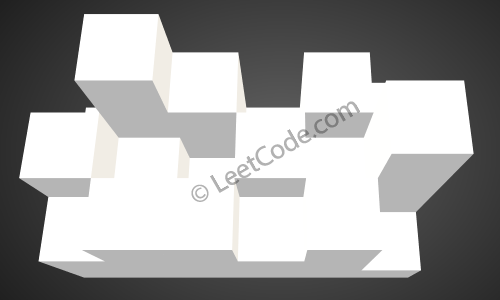
The above image represents the elevation map
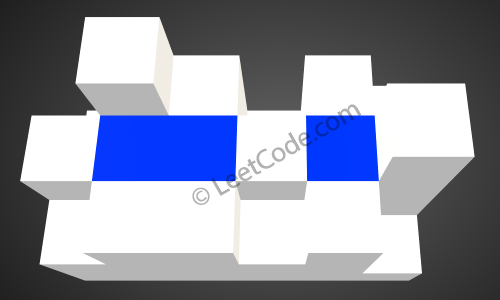
After the rain, water are trapped between the blocks. The total volume of water trapped is 4.
解题思路:
这道题就是用dfs来解,先把四条边按照高低放进去minheap,然后依次poll出做dfs。
Link: https://discuss.leetcode.com/topic/62892/java-solution-beating-100
代码:
https://leetcode.com/problems/trapping-rain-water-ii/description/
题目:
Given an
m x n matrix of positive integers representing the height of each unit cell in a 2D elevation map, compute the volume of water it is able to trap after raining.
Note:
Both m and n are less than 110. The height of each unit cell is greater than 0 and is less than 20,000.
Both m and n are less than 110. The height of each unit cell is greater than 0 and is less than 20,000.
Example:
Given the following 3x6 height map:
[
  [1,4,3,1,3,2],
  [3,2,1,3,2,4],
  [2,3,3,2,3,1]
]

Return 4.
The above image represents the elevation map
[[1,4,3,1,3,2],[3,2,1,3,2,4],[2,3,3,2,3,1]] before the rain.After the rain, water are trapped between the blocks. The total volume of water trapped is 4.
解题思路:
这道题就是用dfs来解,先把四条边按照高低放进去minheap,然后依次poll出做dfs。
Link: https://discuss.leetcode.com/topic/62892/java-solution-beating-100
代码:
private static class Cell implements Comparable<Cell> {
        private int row;
        private int col;
        private int value;
        public Cell(int r, int c, int v) {
            this.row = r;
            this.col = c;
            this.value = v;
        }
        // min heap        @Override        public int compareTo(Cell other) {
            return value - other.value;
        }
    }
    private int water;
    private boolean[][] visited1;
    public int trapRainWater(int[][] heightMap) {
        if (heightMap.length == 0) return 0;
        PriorityQueue<Cell> walls = new PriorityQueue<Cell>();
        water = 0;
        visited1 = new boolean[heightMap.length][heightMap[0].length];
        int rows = heightMap.length, cols = heightMap[0].length;
        //build wall;        // smallest to the left-top most of all the borders        for (int c = 0; c < cols; c++) {
            walls.add(new Cell(0, c, heightMap[0][c]));
            walls.add(new Cell(rows - 1, c, heightMap[rows - 1][c]));
            visited1[0][c] = true;
            visited1[rows - 1][c] = true;
        }
        for (int r = 1; r < rows - 1; r++) {
            walls.add(new Cell(r, 0, heightMap[r][0]));
            walls.add(new Cell(r, cols - 1, heightMap[r][cols - 1]));
            visited1[r][0] = true;
            visited1[r][cols - 1] = true;
        }
        //end build wall;        while(walls.size() > 0) {
            Cell min = walls.poll();
            visit(heightMap, min, walls);
        }
        return water;
    }
    private void visit(int[][] height, Cell start, PriorityQueue<Cell> walls) {
        fill(height, start.row + 1, start.col, walls, start.value);
        fill(height, start.row - 1, start.col, walls, start.value);
        fill(height, start.row, start.col + 1, walls, start.value);
        fill(height, start.row, start.col - 1, walls, start.value);
    }
    private void fill(int[][] height, int row, int col, PriorityQueue<Cell> walls, int min) {
        if (row < 0 || col < 0) return;
        else if (row >= height.length || col >= height[0].length) return;
        else if (visited1[row][col]) return;
        else if (height[row][col] >= min) {
            walls.add(new Cell(row, col, height[row][col]));
            visited1[row][col] = true;
            return;
        } else {
//         System.out.println(row + ", " + col + " height = " + height[row][col] + ", bar = " + min);            water += min - height[row][col];
            visited1[row][col] = true;
            fill(height, row + 1, col, walls, min);
            fill(height, row - 1, col, walls, min);
            fill(height, row, col + 1, walls, min);
            fill(height, row, col - 1, walls, min);
        }
    }

Comments
Post a Comment